If you are interested in partnering with us, please get in touch. Using P4I's flexible, innovative tools and diverse global expertise, we are confident we can design a response that is tailored to your needs.




Maritime transport is central to Southeast Asia’s economy, enabling trade, connecting markets, and supporting regional development. It is also a significant source of greenhouse gas (GHG) emissions. Globally, shipping accounts for around 3 per cent of total emissions, with most vessels still reliant on fossil fuels.
In response, the International Maritime Organization (IMO) has committed global shipping to net-zero emissions by 2050, consistent with the Paris Agreement on Climate Change. For ASEAN member states, the challenge is translating these ambitions into practical, investable solutions.
Australia’s Partnerships for Infrastructure (P4I), funded by the Department of Foreign Affairs and Trade (DFAT), is supporting this transition. Working with ASEAN governments, port authorities, and industry, P4I provides technical studies, policy advice, and regulatory support to help decarbonise ports and shipping across the region, including in Malaysia, Thailand, and Vietnam.
Malaysia has set a clear ambition to become a regional hub for green bunkering, the refuelling of vessels with low-carbon fuels. With P4I support, the Ministry of Transport developed a Green Bunkering Regulatory Roadmap, targeting 40 per cent of maritime fuel to be low carbon by 2050.
Supported by a P4I-funded business case study, the roadmap outlines policy and investment priorities, including financing incentives and guidance on technology adoption. It aligns Malaysia’s national objectives with IMO climate goals, sending a clear signal to industry that Malaysian ports are preparing for a transition to carbon-neutral fuelling operations.
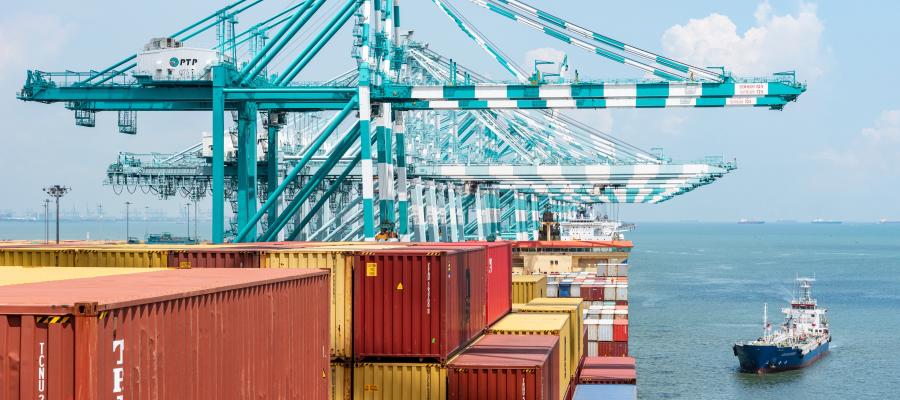
The Port of Tanjung Pelepas (PTP) is demonstrating early leadership. One of Southeast Asia’s busiest transhipment ports, PTP commenced pilot bunkering operations in 2024 using alternative fuels, including liquefied natural gas (LNG) and methanol. The trials confirmed the port’s readiness to handle new fuels and provided evidence of strong economic potential.
Early findings indicate that green bunkering operations at PTP could contribute more than US$60 million to national GDP and create up to 300 green jobs. Major shipping lines have responded, with methanol-powered container vessels operated by Maersk now calling at PTP on scheduled routes. As methanol and future fuels such as green ammonia have lower energy density than conventional fuels, vessels require more frequent refuelling, positioning Malaysian ports as strategic nodes on global shipping routes.
P4I is also supporting cross-border collaboration. Under a P4I initiative, PTP and Australia’s Port of Melbourne are exploring a green shipping corridor, focused on shared research, aligned standards, and low-carbon trade. The partnership demonstrates how P4I is leveraging Australia’s expertise and Malaysia’s strategic location to catalyse maritime decarbonisation.
Thailand is progressing maritime decarbonisation through planning, technology adoption, and regional knowledge exchange supported by P4I. The Marine Department and the Port Authority of Thailand (PAT) have partnered with P4I to assess decarbonisation pathways for major ports, including Laem Chabang and Map Ta Phut.
This work examines the technical and economic feasibility of alternative-fuel bunkering and explores the potential for a green shipping corridor with a neighbouring ASEAN port. The findings will inform PAT’s long-term Green Port Master Plan, aligned with the IMO’s net-zero strategy.
Alongside planning, Thai ports are modernising operations. Under PAT’s Green Port Strategy, terminal operators at Laem Chabang have begun deploying electric and automated equipment to improve efficiency and reduce emissions. DP World, a global terminal operator at Laem Chabang, has introduced Thailand’s first fleet of electric intra-terminal trucks. These battery-operated vehicles reduce exhaust GHG emissions by around 60 per cent compared to diesel equivalents.
DP World plans to convert its entire yard vehicle fleet to electric models by 2030, reducing the terminal’s carbon footprint by approximately 12 per cent relative to its 2022 baseline. The port has also initiated on-site solar power generation to reduce Scope 2 emissions and green its energy mix.
P4I has supported Thailand’s transition through targeted knowledge exchange. In 2025, Thai transport officials and port executives joined counterparts from Malaysia and Vietnam in a Maritime Decarbonisation Technical Exchange in Melbourne. The program included site visits to an automated, electrified container terminal and discussions with Australian experts on port electrification, digitalisation, and fuel safety standards.
These insights are informing PAT’s efforts to enhance marine fuel standards, adopt alternative fuels, and deploy cleaner vessel technologies in line with IMO’s 2050 goals.
Vietnam, a rapidly growing maritime nation, is also working with P4I to prepare for cleaner shipping. A green marine fuel feasibility study, supported by P4I and conducted in partnership with the Vietnam Maritime Administration and the state-owned fuel provider Petrolimex, has assessed the technical, commercial, and safety considerations of supplying alternative fuels at Vietnamese ports.
By engaging regulators and industry together, the study supports the development of a realistic roadmap for alternative bunkering infrastructure. Vietnam has committed to international timelines, signalling that domestic vessels should meet IMO emissions standards by 2050. The country plans to begin decarbonising its major ports from 2031, allowing time to pilot new technologies and build institutional capacity.
The P4I-supported program enables Vietnam to draw on regional experience, including Malaysia’s bunkering roadmap and Thailand’s green port strategies. Vietnam is updating legislation to encourage cleaner fuels in coastal shipping, while state-owned entities such as Vietnam Maritime and Water Administration (VIMAWA) and Petrovietnam are exploring investment opportunities in fuel storage and production.
As an output of the feasibility study, Vietnamese officials will have data on costs, benefits, and regulatory adjustments needed to initiate green bunkering at strategic ports, including Cai Mep–Thi Vai and Hai Phong. The resulting evidence-based green port roadmap will support Vietnam’s net-zero ambitions while driving sustainable growth in the maritime sector.
In 2025, officials from Malaysia, Thailand, and Vietnam met under P4I’s auspices to share progress and lessons learned. Discussions highlighted that many decarbonisation measures, including fuel safety regulations, digital systems, and workforce training, are more effective when coordinated at the regional level.
P4I is assisting the ASEAN Secretariat to improve port connectivity and standardise digital systems, helping deliver efficiency gains alongside emissions reductions. Regional priorities include ASEAN-wide collaboration on fuel standards and bunker quality, regulatory harmonisation aligned with IMO requirements, and capacity building to ensure crews and port workers can safely handle fuels such as methanol and ammonia.
Ports that delay action on green bunkering and low-emission operations risk losing competitiveness. Conversely, Southeast Asian ports that move early are positioning themselves to gain market advantage in a carbon-constrained future.
P4I works strategically to enable policy reform, technical analysis, and pilot projects that share knowledge across borders. Its demand-driven approach supports national priorities while fostering continuous regional learning.
If you are interested in partnering with us, please get in touch. Using P4I's flexible, innovative tools and diverse global expertise, we are confident we can design a response that is tailored to your needs.